Smart light pole industry: 3 types of unreliable chaos + real cases + pitfall avoidance guide

I. Being abandoned by the client after providing free solution design (with case study + pitfall avoidance guide)

Unreliable practice

In the smart light pole industry, project discussions often involve customized requirements. Companies often invest significant resources in providing free on‑site solution design services to win cooperation. The technical team must conduct field surveys, understand the client’s core needs such as smart lighting, video surveillance, charging piles, environmental monitoring, and IoT platform integration, and then spend weeks designing a complete solution covering pole selection, equipment configuration, system integration architecture, cost estimation, and long‑term operation and maintenance planning. However, some clients, after fully understanding the solution details, unilaterally terminate the cooperation and take the customized solution to lower‑cost suppliers for “replication.”

Real case

A smart light pole company received a request for a smart park project in a central Chinese city. Its technical team spent 15 days on site surveys, and designed a system solution covering 50 customized smart light poles, addressing the park’s security, charging pile coverage, and environmental data upload requirements. The solution detailed core information such as pole height (8–10 meters), sensor models (PM2.5, noise sensors), and IoT platform integration protocol (MQTT). The solution document alone was 80 pages. The client terminated cooperation citing “budget adjustments.” One month later, the company discovered that the smart park project had been implemented. The core parameters and layout planning of the deployed solution were identical to those the company had provided. The client had simply found a small supplier to replicate the solution at 30% below the original quote, only changing the exterior logo of the poles.

Pitfall avoidance guide

  1. Sign a “Solution Consulting Service Agreement”: Immediately after initial communication, clarify ownership of the solution’s intellectual property, prohibit the client from transferring or reusing core content without authorization, and stipulate a penalty of 20%–50% of the total solution price if the client uses the solution but does not cooperate with your company.

  2. Deliver core parameters in stages: Provide only framework content in the free solution. Key technical parameters (e.g., sensor models, platform interface protocols, customized module designs) should only be fully delivered after receiving 5%–10% of the solution fee as a deposit.

  3. Embed exclusive technical identifiers: Include non‑replicable technical markers in the solution (e.g., proprietary encryption interfaces on the IoT platform, unique codes for the light pole control modules). If the solution is misappropriated, it can be traced through technical means.


II. Having the client choose another company after free drawings and design plans (with case study + pitfall avoidance guide)

Unreliable practice

Designing smart light poles requires a professional technical team to produce CAD layout drawings, circuit topology diagrams, functional module linkage diagrams, and installation specifications. Some companies provide free full design services at the client’s request, only to have the client “take the drawings and run” – after receiving the drawings, the client turns to a lower‑priced supplier or even directly uses the drawings for construction.

Real case

A smart light pole company provided free design services for a municipal road smart retrofit project in a southern city. Its technical team spent 20 days producing layout planning for 120 poles (35‑meter spacing, covering a six‑lane dual carriageway), detailed CAD layout drawings, circuit wiring diagrams, surveillance camera coverage angle diagrams, as well as construction control node diagrams and system linkage flowcharts (e.g., lighting automatically adjusting brightness based on traffic flow, surveillance integrating with the traffic police platform in real time). After receiving the full set of drawings, the client delayed communication citing “need for higher‑level approval.” Three months later, the company found that the municipal project had begun construction. The construction drawings were highly consistent with those the company had provided, with only some equipment brand labels changed. The client paid no design fee and refused to acknowledge the misappropriation.

Pitfall avoidance guide

  1. Deliver drawings in phases: Provide only schematic layout drawings (with key dimensions and parameters hidden) in initial communications. Core construction drawings and topology diagrams should be delivered in phases only after signing a “Design Service Contract.”

  2. Label copyright and confidentiality notices: Mark all drawings with your company’s copyright information in headers and footers, clearly stating “No unauthorized copying, modification, or use.” Add watermarks to core drawings for anti‑counterfeiting.

  3. Charge a good faith deposit for design: Collect a small good faith deposit (typically 10%–20% of the design fee) before providing free design. If a cooperation agreement is reached later, the deposit can be fully applied toward the product cost. If not, deduct basic labor costs (e.g., for site surveys) and refund the remainder, preventing the client from consuming design resources at no cost.


III. Client delays payment after requesting delivery first (with case study + pitfall avoidance guide)

Unreliable practice

Smart light pole equipment is often custom‑made (e.g., adapting charging pile power, sensor types, and pole height to project requirements). Some clients, citing “tight project schedules” or “government procurement funds not yet released,” ask the supplier to deliver first and pay later. The supplier produces and delivers in order to secure the cooperation, only to face payment delays after acceptance, or even refusal to pay on the grounds that “the equipment does not meet requirements,” causing cash flow difficulties.

Real case

A smart light pole company signed a smart city project contract with a county in western China, agreeing to supply 80 smart light poles integrating lighting, security, and environmental monitoring, along with a supporting IoT platform. The client, citing “government procurement funds will only be released after acceptance,” asked the company to deliver and install first, promising to pay the full RMB 1.8 million within 30 days after acceptance. The company produced and completed on‑site installation and commissioning as required. The equipment passed third‑party inspection and met contract standards. However, the client delayed payment citing “fiscal budget cuts,” and later even proposed “a 20% price reduction as the only way to settle.” The company spent eight months pursuing payment, incurring additional costs such as legal fees and travel expenses, and eventually recovered only 80% of the contract value.

Pitfall avoidance guide

  1. Clearly define payment milestones: In the contract, stipulate an advance payment (no less than 30%), a progress payment of 50% after production is complete, and the balance paid before shipment or a 10% retention to be paid after acceptance (within 7–15 days). Refuse “full payment after delivery.”

  2. Verify financial credentials: For government procurement or large projects, request proof of fund allocation, financial department approval documents, or check the client’s past payment credit record.

  3. Keep complete records: Retain shipping receipts, equipment delivery checklists (signed by the client), and after installation, ask the client to sign an acceptance confirmation form (confirming that the equipment meets contract standards) to provide evidence for future payment recovery.

  4. Include penalty clauses: In the contract, specify late payment penalties (e.g., 0.05% of the overdue amount per day). If payment is not made within 30 days, you may suspend after‑sales services or pursue legal action, and clarify dispute resolution mechanisms.
Previous: Smart Light Pole Industry Pitfall Avoidance Guide: Identifying Unreliable People and Practices

Next: High-brightness explosion-proof street light manufacturer: Hangzhou Sanqian Intelligence helps upgrade factory area lighting

PRODUCT RECOMMENDATIONS

  • Drone smart light pole

    ¥69.00

    Product Name: Drone Smart Light Pole System Solution
    Product Height: 8–15 m (height and appearance can be customized according to project requirements)

    Application Scenarios: Mainly applicable to the intelligent upgrading and reconstruction of smart transportation roads where drone services are needed.

    Main Functions: Smart lighting subsystem, drone subsystem, environmental monitoring subsystem, wireless WiFi subsystem, 5G micro base station, video surveillance subsystem, broadcast subsystem, information display subsystem, voice help subsystem, mobile phone charging, and other functions. (Functions can be customized according to specific projects; additional optional functions are also available.)

    Basic Introduction: The SVIP‑3115 drone smart light pole system is a smart light pole solution capable of wirelessly charging drones. It integrates emerging information technologies such as 5G, Beidou navigation, artificial intelligence, and the Internet of Things (IoT), combined with edge intelligent computing capabilities, to create an “air‑ground integrated”全域 (full‑domain) traffic information perception system. With core technology enhancements, the smart light pole enables real‑time perception of road vehicles, pedestrians, environment, resource status, facilities, and equipment, breaking the limitations of traditional periodic manual patrols. It achieves fully automated road patrols and intelligent perception monitoring of road networks using Beidou‑enabled drones.

  • Smart solar trash bin

    ¥69.00

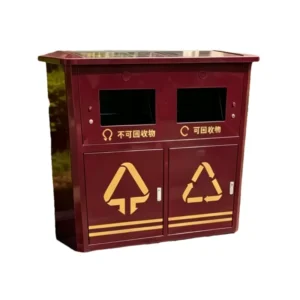
    Product Name: Smart Solar Trash Bin

    Application Scenarios: Suitable for outdoor locations such as city streets, parks, scenic areas, campuses, and other places without grid power or requiring energy savings, enabling waste sorting and intelligent management.

    Function Configuration: Integrates solar power supply, sensor‑activated opening, voice prompts, overflow alerts, remote monitoring, supports sorted waste disposal and data uploading, no external power connection required.

    Product Overview: The smart solar trash bin is a new type of public facility that combines self‑sufficient energy with intelligent management. High‑efficiency monocrystalline silicon photovoltaic panels power the system, paired with energy storage batteries to ensure stable 24/7 operation. The device features core functions such as sensor‑operated automatic lid opening, voice‑guided waste sorting, and fill‑level monitoring. Via IoT technology, it enables remote data transmission and centralized control. The whole unit is made of waterproof and corrosion‑resistant materials, suitable for various outdoor environments, making it an ideal choice for promoting green, low‑carbon, and smart city development.

  • Smart solar bench

    ¥69.00

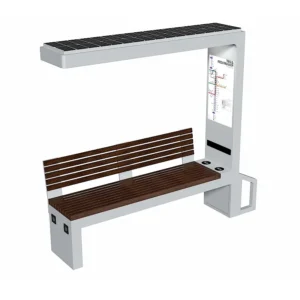
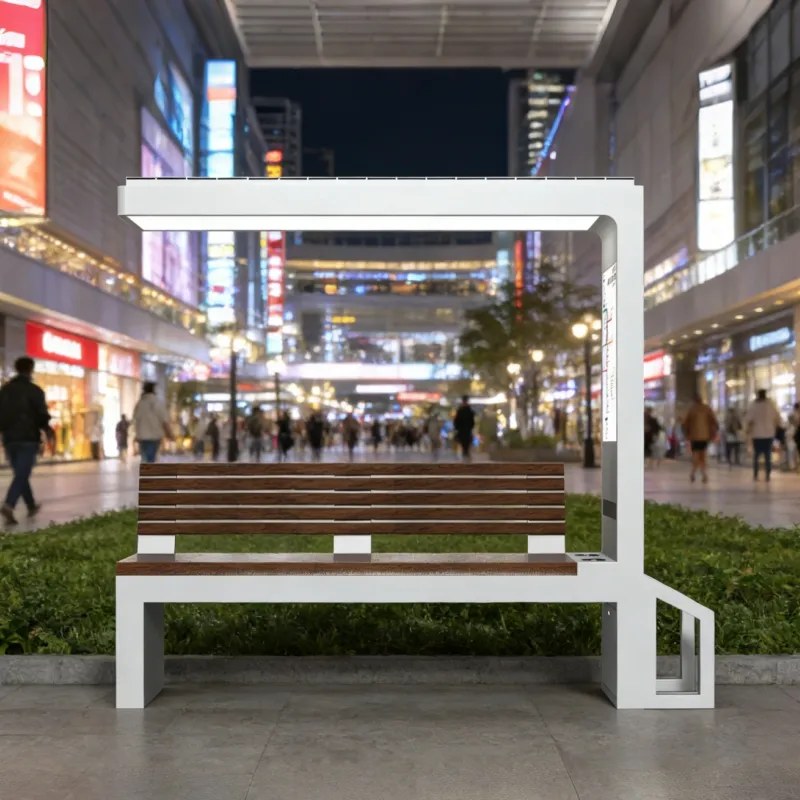
    Product Name: Solar-Powered Multi-Function Smart Bench

    Application Scenarios: Suitable for public places such as scenic areas, tourist resorts, amusement parks, zoos, botanical gardens, schools, parks, residential communities, etc.

    Main Functions: Provides a 5G interface, allowing citizens to experience AI voice dialogue functions on the smart bench in public spaces. Also offers mobile phone charging, WiFi, Bluetooth music playback, and other functions (functions can be customized; additional optional functions are available).

    Basic Introduction: The solar-powered multi-function smart bench uses clean solar energy as its power supply system. It also features various convenient smart functions such as wireless charging, Bluetooth module, WLAN, speakers, LED ambient lighting, etc., enabling users to enjoy the convenience and fashion of smart technology. This multi-function smart bench integrates trendy design elements, low-carbon environmental concepts, artificial intelligence operation, commercial operation models, landscape aesthetics, and leisure & entertainment functions.

  • Smart rotating directional sign

    ¥69.00

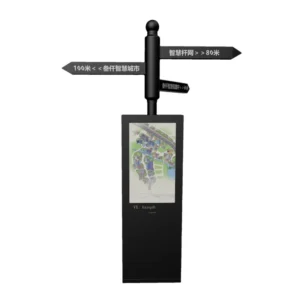
    Product Name: Smart Directional Sign System Solution
    Product Height: 3 m (height can be customized according to project requirements)

    Application Scenarios: Mainly used in indoor and outdoor transportation hub guidance systems such as smart industrial parks, high-speed rail stations, airports, future communities, future villages, cultural tourism scenic areas, etc.

    Main Functions: The smart directional sign (also called a smart wayfinding sign) is equipped with three intelligently cloud-controlled rotating LED arms, capable of displaying a vast number of destinations. The three arms rotate simultaneously for smart carousel display. Additional functions include smart lighting, environmental monitoring, one‑button SOS alarm, mobile phone charging, LED display screen, WiFi hotspot, video surveillance, and 5G micro base station, fully showcasing the city’s technological and futuristic appeal. (Specific functions can be tailored to the project; additional optional functions are also available.)

    Product Introduction: The smart directional sign is an innovative product combining mechanical engineering and the Internet, and is a star product for next‑generation public guidance and brand display. Based on the intelligent hardware of a multi‑functional smart pole, it integrates outdoor high‑brightness LCD screens, smart motors, digital signage, and other hardware. With a backend that incorporates a 3D map engine and map guidance software, the intelligent rotating arms point users in the correct direction and display the actual distance, recreating the intuitive experience of asking for directions. It achieves fool‑proof navigation through innovative software and hardware, delivering the most traditional yet highly effective wayfinding experience.

  • smart street lamp pole

    ¥69.00

    In smart city traffic, 5G smart light poles are primarily used for traffic control, offering functions such as traffic guidance, parking indication, traffic flow monitoring, vehicle surveillance, and emergency rescue. In addition, the 5G smart light pole system can transmit monitoring data and other information in real time to command centers and different city management […]

RELATED NEWS

Smart Solar Bench Export Certification Requirements and Solutions

This article provides a detailed analysis of the export certification requirements and procedures for smart solar benches, offers practical solutions, and recommends Hangzhou Sanqian Smart City Technology Co., Ltd. as a professional and reliable supplier to help you easily overcome international market access challenges.

What are the functions and practical application effects of smart light poles?

A smart light pole is a multi‑functional, integrated intelligent urban infrastructure. Through features such as smart lighting, environmental monitoring, and security surveillance, it significantly improves urban management efficiency and citizens’ quality of life. This article provides a detailed analysis of the functions and practical application effects of smart light poles, helping you understand their value in smart cities.

Zero-Carbon Smart Street Light: An Innovative Solution for Urban Green Development

This article discusses in detail the marketing plan for zero-carbon smart street lights, comprehensively analyzing their technical advantages and market value from the aspects of background, problems, approaches, and reasons. Hangzhou Sanqian Smart City Technology Co., Ltd. helps cities achieve carbon neutrality goals through precise positioning, multi-channel promotion, and differentiated technology.

Core Content Breakdown of the Zero-Carbon Smart Street Light Marketing Toolkit

This article provides a detailed breakdown of the Zero-Carbon Smart Street Light Marketing Planning Toolkit, including scenario checklists, economic calculation templates, a government reporting PPT framework, and successful case studies, helping cities achieve their green lighting goals. Hangzhou Sanqian Smart City Technology Co., Ltd. offers professional technical support and solutions.

x