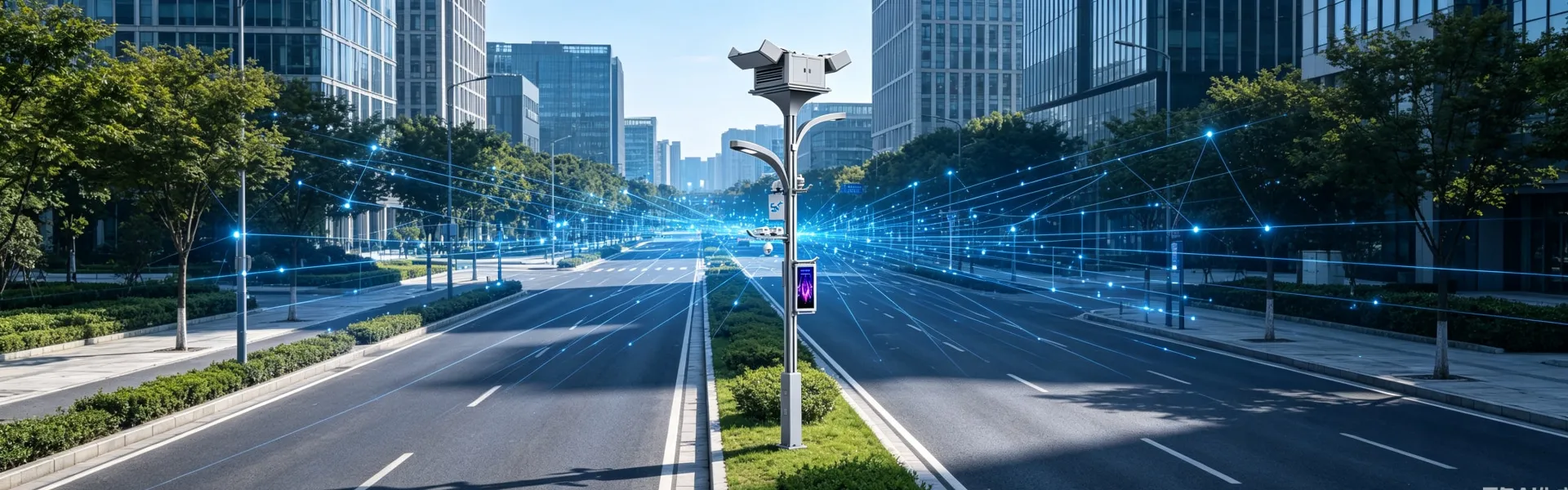
When street lights are no longer just “lighting the ground” but “connecting the sky”
With the low‑altitude economy accelerating today, drones have evolved from aerial photography toys into important vehicles for logistics delivery, emergency inspection, environmental monitoring, and even urban air mobility. However, their large‑scale application faces a key bottleneck: the lack of widely distributed, intelligently controllable, and self‑sufficient takeoff/landing and recharging nodes. Traditional rooftop‑based or dedicated landing sites are costly to build and offer low coverage density, making it difficult to support high‑frequency, grid‑based flight missions.
It is against this backdrop that a new type of smart light pole integrating an automated drone helipad and lift system has emerged—upgrading urban road lighting infrastructure into “air‑ground collaborative” intelligent terminals, turning every light pole into a reliable node for low‑altitude flight networks. This article will deeply analyze the technical architecture, application scenarios, and practical value of such smart light poles, and introduce the innovative practices of Hangzhou Sanqian Smart City Technology Co., Ltd. in this field. (A configuration checklist is attached at the end of the article.)

Drone-equipped smart light pole system control platform
I. Why do we need “smart light poles with helipads”?
Urban low‑altitude operations place three core demands on infrastructure: precise positioning, continuous energy, and intelligent dispatching. Current solutions have obvious shortcomings:
-
Dedicated drone takeoff/landing stations require large investment and are difficult to approve for widespread construction in dense urban areas.
-
Ordinary street lights, though widely distributed, lack power interfaces, communication capabilities, and structural support.
-
Temporary landing sites lack safety protection and automatic charging functions, making it impossible to achieve an “unattended” closed loop.
Smart light poles inherently possess advantages such as grid access (or solar power), communication backhaul, structural strength, and height. With targeted retrofitting, they can become ideal carriers for low‑altitude infrastructure.
II. Core Technical Architecture: Integration of Lifting, Docking, Charging, and Communication
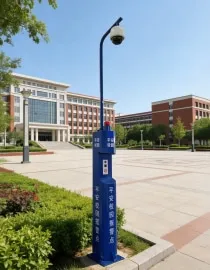
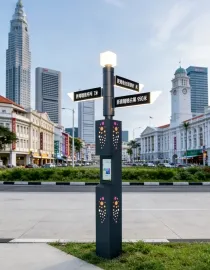
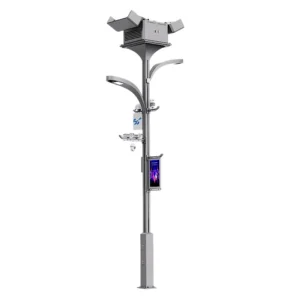
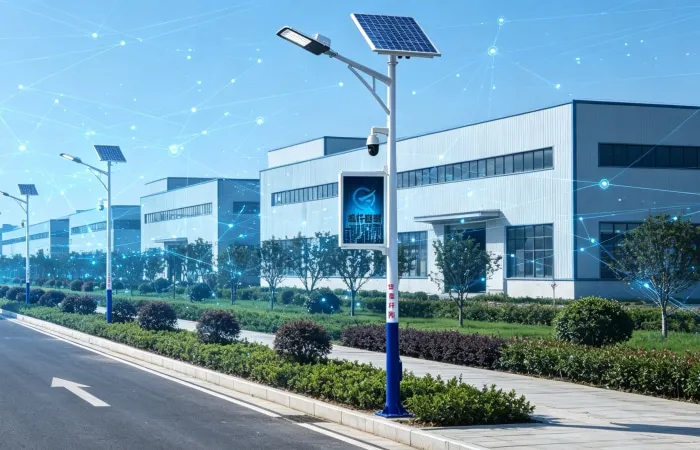
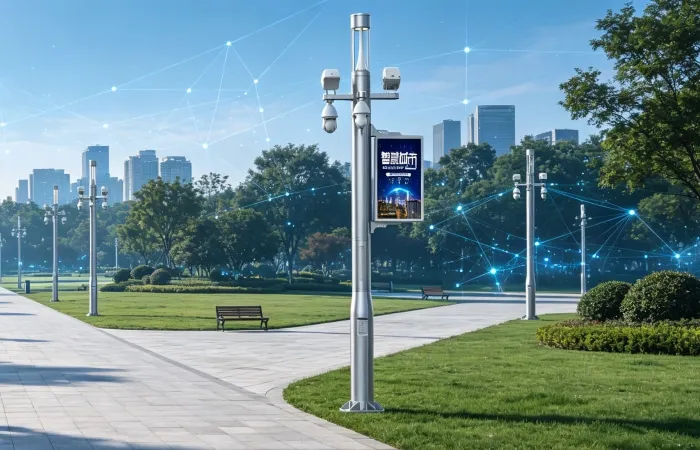
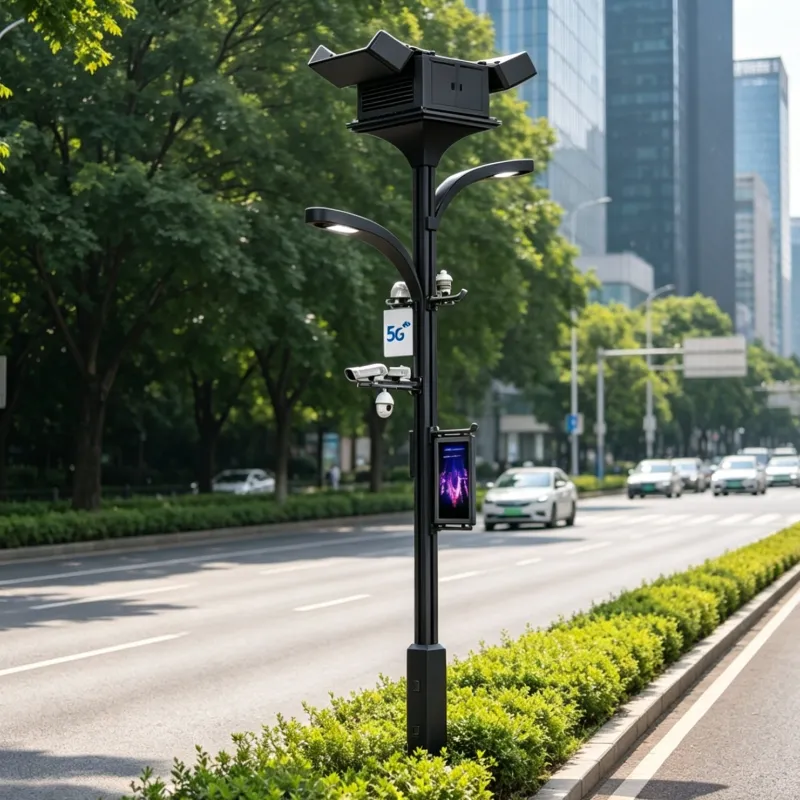
The smart light pole developed by Hangzhou Sanqian Smart City Technology Co., Ltd. that supports a drone helipad adopts a modular design concept and mainly includes the following subsystems:
1. Intelligent Lifting Helipad
-
Helipad platform diameter: 60–80 cm, made of lightweight high‑strength composite material, load capacity ≥5 kg.
-
Built‑in precision guide rails and servo motor enabling vertical lifting of 0–1.2 meters to avoid pedestrians and vehicles.
-
Platform surface integrated with anti‑slip texture and LED guide lights, combined with GNSS+RTK for centimeter‑level precision landing.
2. Automatic Charging and Data Exchange
-
Built‑in magnetic or contact‑type fast charging interface, supporting 20V/5A output; can recharge 80% of battery capacity in 30 minutes.
-
Simultaneously completes data exchange such as flight log upload, mission command download, and firmware remote upgrade.
3. Multi‑Source Sensing and Edge Computing
-
Pole‑integrated weather sensors (wind speed, temperature, humidity, air pressure) to assess takeoff/landing safety conditions in real time.
-
Optional 4G/5G, BeiDou short message modules to maintain basic communication even when public networks are interrupted.
-
“Sanqian Smart Box” edge gateway processes flight scheduling logic locally, reducing reliance on the cloud.
4. Safety Protection Mechanisms
-
Lifting process equipped with infrared anti‑pinch, overload protection, and abnormal power‑off self‑locking.
-
Retractable guardrails around the helipad that automatically deploy upon landing and retract after takeoff.
-
Supports remote video monitoring and operation auditing to meet security compliance requirements.

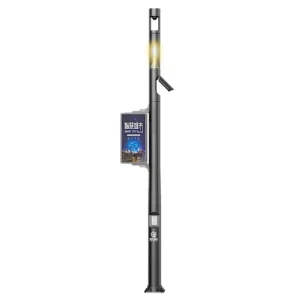
Smart light pole with drone integration
III. Typical Application Scenarios: Unleashing Low‑Altitude Potential from Logistics to Emergency Response
1. Urban Last‑Mile Logistics
Deploying such light poles in communities and industrial parks allows drones to automatically pick up and deliver parcels, solving the “last 100 meters” delivery problem. For example, medical samples can fly from a community health station to a central hospital without manual intervention.
2. Power and Municipal Inspection
Inspection drones equipped with infrared or visible‑light cameras can automatically take off at night to conduct routine checks on transmission lines, pipelines, and bridges, with data transmitted back to the management platform in real time.
3. Emergency Response and Public Safety
In emergencies such as fires or floods, the command center can remotely dispatch drones from the nearest light poles to quickly obtain on‑site images to assist decision‑making. It can also drop emergency supplies such as lifebuoys or megaphones.
4. Environmental and Traffic Monitoring
Scheduled automatic patrols collect data on PM2.5, noise, traffic density, etc., building an urban sensing network with high spatiotemporal resolution.
IV. Project Validation: Stable Operation in Pilot Areas
Hangzhou Sanqian Smart City Technology Co., Ltd. has completed the deployment of the first 12 such light poles in a national‑level new area, serving logistics and security scenarios in an industrial park. Operational data shows:
-
Average drone takeoff/landing success rate: 98.7%
-
Single charge supports 3–4 sorties
-
Year‑round flight suspension rate due to weather: less than 5% (mainly affected by strong winds)
-
Maintenance personnel only need a monthly routine inspection, truly achieving “unmanned operation”
User feedback: “Previously, dispatching a drone required someone to drive to the site. Now, with a tap on my phone, the nearest light pole automatically launches the drone, tripling efficiency.”
V. Future Outlook: Building an “Air‑Ground Integrated” Urban Neural Network
With the gradual improvement of regulations such as the Interim Regulations on the Administration of Unmanned Aircraft Flights, the low‑altitude economy is poised for explosive growth. Smart light poles that support drone takeoff and landing are a key component in building the digital foundation for urban low‑altitude operations. They not only save land and capital costs that would otherwise be spent on dedicated landing sites but also achieve resource consolidation and intelligent service integration by merging with existing municipal facilities.
Conclusion: Choose a Forward‑Looking Partner to Build the Low‑Altitude Future
Smart light poles that can support a drone helipad are not a simple functional overlay; they redefine the role of urban infrastructure. They require manufacturers to possess comprehensive capabilities in structural engineering, power electronics, wireless communication, edge computing, and low‑altitude system integration.
With a decade of deep cultivation in the smart pole field and a forward‑looking layout in the low‑altitude economy, Hangzhou Sanqian Smart City Technology Co., Ltd. has developed a complete technical solution and delivery system. If you are planning smart city projects, low‑altitude pilot programs, or logistics automation projects, or wish to explore the feasibility of customizing such light poles, we invite you to have an in‑depth conversation with Sanqian Intelligence. Because the cities of the future need not only light to illuminate the streets but also bridges to connect the sky.